

Zest.Golf: Strategic Positioning, Founders’ Story & Investment Analysis
Zest.Golf has entered the next phase of its growth and has officially been part of the Dutch Sport Tech Fund 1 (DSTF1) portfolio since 2022. Zest provides the technical infrastructure needed to digitalise the global golf market. This article explores the origins, strategic positioning, business model and future vision of Zest.Golf, alongside a critical investment analysis and assessment of the key risk factors from DSTF’s perspective.
1. Origins & the fragmented golf market
Zest.Golf was founded on more than 50 years of combined experience in golf club management, player services, tournament organisation, golf technology and golf travel. Having worked across every part of the industry — from golf courses themselves to travel operators — the founders identified a persistent problem: disconnected tee-time management systems (tee sheets) and fragmented sales channels were limiting the reach of golf courses.
There were relatively few websites selling tee times directly to golfers, despite the existence of a large golf travel market served by tour operators. The problem? Much of this market still relied on manual processes involving emails, phone calls, individual spreadsheets and outdated software. Golf courses operated on different systems, forcing tour operators to build separate integrations with each course.
Zest was created to make this inventory digitally accessible and directly bookable. Over the past 12 months, the market has evolved rapidly: Zest now receives requests for access to its Booking API almost daily, and more than 300 sales channels have registered on the platform.
This demand revealed the real opportunity: not simply making the existing travel market more efficient, but building the foundation for how golf will be sold in the future. Zest therefore focuses on three core pillars:
-
Booking API infrastructure for online marketplaces, travel companies and distribution channels.
-
White-label solutions that enable businesses to offer their own digital golf travel services.
-
AI-powered distribution, providing the real-time inventory required by AI assistants and emerging travel platforms.
Zest is not building a consumer-facing website. Instead, it provides the technology operating behind the scenes. As digital platforms and AI agents increasingly shape how people book travel, Zest delivers the real-time data infrastructure needed to support this transformation.
2. The “B2B Connectivity Hub” & Golf Course Adoption
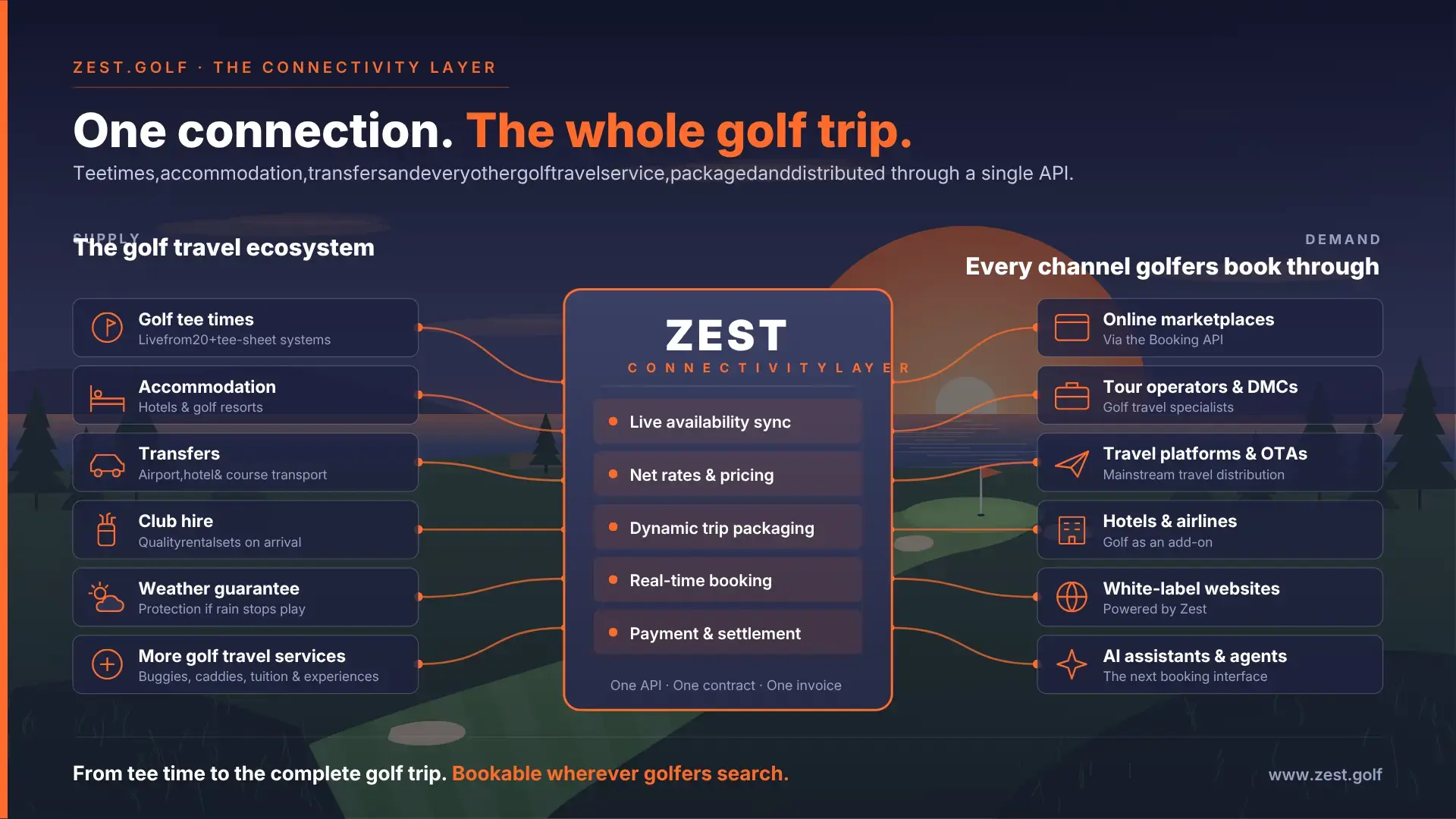
Zest operates as the B2B connectivity hub behind golf distribution. A golf course integrates with Zest once and immediately gains access to a network of marketplaces, travel companies, tour operators, white-label websites and AI-powered channels. Conversely, a distribution partner only needs to integrate with Zest once, rather than building hundreds of individual connections.
Currently, this network connects more than 300 golf courses with over 300 sales channels.
For golf courses, this delivers greater reach and greater control:
-
Restoring the balance of power: Historically, major tour operators held considerable negotiating power, often resulting in substantial discounts. Zest provides golf courses with additional sales channels, reducing their dependence on a small number of dominant players.
-
Higher revenues: More effectively distributed demand increases occupancy rates and revenue per tee time through yield management.
-
Full control: Golf courses retain control over their own inventory, pricing and booking conditions.
-
No financial risk: Joining the platform is free for golf courses, operating on a no-cure, no-pay basis. Zest only earns revenue when an actual booking is made.
Zest’s Channel Manager connects a golf course’s tee-time management system to the distribution network. This reduces manual administration and prevents double bookings. The API then makes available inventory accessible to partner websites and AI applications.
3. Revenue Model & Scalability
Zest is transitioning from a traditional SaaS model towards a transaction-based infrastructure model. Revenue is generated through the booking volume flowing through its network.
An important development is that Zest enters into contracts directly with golf courses. This secures direct access to inventory and agreed net rates. After all, the main bottleneck in golf distribution has never been demand, but rather the lack of reliable, automated access to tee-time availability.
By securing net rates and reselling inventory, Zest captures a share of the transaction margin. The model is capital-efficient: Zest does not need to acquire consumers itself, but instead provides the technology that enables its partners to do so.
4. The Future of Golf Distribution & AI
The Zest ecosystem serves the entire value chain:
-
Tee-time software providers
-
Golf federations, resorts and golf groups
-
Golf travel operators and online marketplaces
-
Travel platforms, hotel chains and airlines
Europe presents a significant opportunity due to the highly fragmented nature of its national markets. The United States represents a major longer-term growth opportunity.
The market is shifting from manual, relationship-driven processes towards open, digital and AI-powered distribution.
When a consumer asks an AI assistant, “Find me a golf trip to Portugal in November, including three rounds of golf, accommodation and transport,” that AI needs live access to inventory and pricing.
Zest provides this data layer and is already expanding its capabilities to include hotel rooms, transfers and golf club rentals.
“We don’t want to compete with marketplaces. We want to be the engine behind them. Our goal is for Zest to become the global infrastructure for golf distribution.”
5. Strategic Analysis & Investment Assessment (DSTF)
Zest.Golf presents a compelling proposition and demonstrates a realistic understanding of the B2B dynamics within the travel industry.
Strengths of the Proposition
-
“Stripe for Golf”: The B2B2C model avoids the extremely high customer acquisition costs (CAC) associated with attracting consumers in the travel industry.
-
AI-ready: AI models can only execute transactions when connected to live data. Zest provides precisely this API connectivity.
-
Margin protection: Direct agreements with golf courses reduce Zest’s dependence on local software providers and help protect its margins.
-
Low barrier to entry: Free onboarding for golf courses accelerates growth on the supply side of the platform.
Key Considerations & Investment Risks
As an investment fund, Dutch Sport Tech Fund takes a critical view of the potential challenges associated with this business model:
-
Traditional golf courses: The golf industry is relatively slow to adopt change. Establishing direct contracts with thousands of courses requires considerable time and sales resources.
-
Dependence on local software: Zest must integrate with legacy tee-time management systems. If software providers restrict access to their systems or introduce high API fees, Zest could face operational and financial challenges.
-
Thin margins require volume: A relatively small fee per booking means Zest needs substantial transaction volumes to achieve meaningful profitability.
-
Limited consumer brand awareness: Because Zest operates behind the scenes, it does not build direct brand recognition among golfers. B2B customers may switch providers if a competitor offers a cheaper API.
-
Risk of disintermediation: Large tour operators that discover popular golf courses through Zest may subsequently attempt to negotiate direct agreements, bypassing the platform fee.
-
Speed is critical: Infrastructure markets often follow a winner-takes-most dynamic. Zest must scale rapidly before major travel companies or US industry giants, such as GolfNow, establish their own API standards.
Conclusion
Zest.Golf is a strong B2B technology company driving the digital transformation of a traditional industry. Its proposition aligns closely with the investment focus of Dutch Sport Tech Fund 1.
If the team maintains its momentum and continues to onboard golf courses at sufficient speed, Zest has the potential to become the global standard for golf distribution.
Let op! U belegt buiten AFM-toezicht. Geen vergunningplicht voor deze activiteit.